Adriana Davis-Tarantino
Operations Manager - Co-Response Jail Diversion Program

Working together for better lives and stronger communities.
Complete our referral form for a person you support or family member in need of services
Sign up to receive our monthly CR-TTAC newsletters.
If you or a loved one needs help now, our caring staff are available. Reach out today.
Join us in making lives better.
Advocates operates pre-arrest Co-Response Programs in multiple police departments across Massachusetts. These programs are founded on the understanding that by working together, clinicians and law enforcement can respond most appropriately to the needs of individuals in the community who are in crisis.
Advocates' award-winning Co-Response model requires extensive collaboration between the clinician and the patrol division. Our clinicians train and work alongside police officers to help respond to crises and determine appropriate outcomes. Cross-training between the police and these embedded clinicians has resulted in mutual understanding and respect for each other’s roles.
Working in the field with Co-Response clinicians allows police officers the opportunity to deliver rapid mental health services to those they encounter. Police departments report that the number of re-occurring calls has decreased as people are referred to more appropriate services.
Co-Response clinicians can facilitate arrest diversions due to immediate presence on the scene. On average, 75% of individuals presenting with criminal behavior are diverted from arrest and into appropriate treatment. Individuals who are not able to be diverted (more serious crimes/mandatory arrests) also receive support, resources, and referrals from the clinician while in police custody.
Given that Co-Response clinicians are on the scene alongside police, they can provide rapid assessment and de-escalation. This allows for a reduction in costly and unnecessary transportation to hospital emergency departments for mental health assessment.
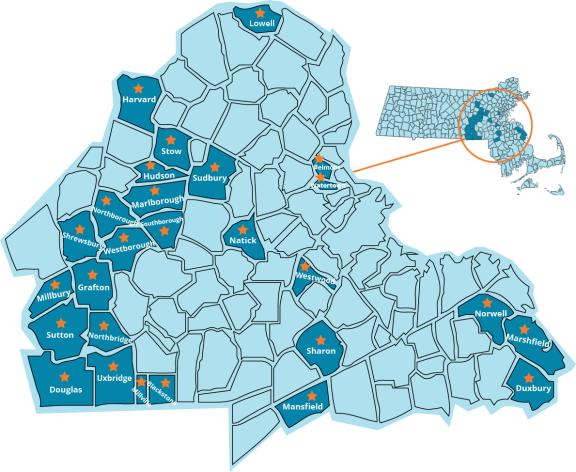
Advocates launched the first Pre-Arrest Co-Response Program in Massachusetts in 2003 at the Framingham Police Department. The model was successfully replicated in Marlborough (2008), Watertown (2011), Natick (2019), and offered on a regional basis in Hudson & Sudbury (2018), Westborough, Southborough, & Northborough (2019), Lowell (2021), Mansfield (2021), Stow & Harvard (2022), Belmont (2022), Shrewsbury (2022), Uxbridge, Blackstone, & Millville (2022), Northbridge & Douglas (2022), Grafton, Millbury, & Sutton (2022), Sharon & Westwood (2022), Marshfield, Duxbury, & Norwell (2022). In 2018, the first Co-Response Training and Technical Assistance Center operating nationally was launched to expand replication efforts throughout Massachusetts.
View our Co-Response Jail Diversion newsletter archive
In this article from The Belmont Voice, Advocates clinician Emily Bartlett and her colleagues at the Belmont Police Department discuss their belief that partnership between police and mental health providers is fundamental to providing excellent care.
Enter Jessica Atwood, who is the department’s new jail diversion program co-response clinician.